How Europe is Turning Organic Waste into Construction Materials
Why This Matters to You
Every year, European households and businesses generate millions of tons of organic waste – food scraps, agricultural residues, orange peels from juice production. Most of this waste ends up burned or in landfills, wasting resources and contributing to climate change.
But what if this waste could become the furniture in your home or the panels in your office building?
Scientists in Valencia, Spain, have developed a revolutionary process that transforms wet organic waste into high-quality construction materials. This isn’t just recycling – it’s chemical transformation that turns yesterday’s garbage into tomorrow’s resources.
The Challenge: Europe’s Waste Mountain
1.4 billion tons per year
That’s how much plant-based waste Europe produces annually. This includes:
- Household food waste and garden trimmings
- Agricultural residues (straw, crop leftovers)
- Food industry waste (orange peels, coffee grounds, etc.)
- Woody waste from forestry and urban green areas
Current disposal methods are problematic:
- Burning: Releases CO₂ and pollutants into the air
- Landfills: Produces methane, a greenhouse gas 28x more potent than CO₂
- Composting: Good but limited applications, transportation costs high
Meanwhile, Europe imports wood and uses petroleum-based plastics for construction, even though we’re sitting on mountains of usable organic material.
The Solution: Chemistry Meets Circular Economy
The process developed at the Instituto de Tecnología Química in Valencia works in three steps:
STEP 1: Hydrothermal Carbonization (HTC)
Wet organic waste (even with 70-80% water content) goes into a pressurized reactor at 200-215°C. This isn’t just heating – the water itself acts as a chemical agent, breaking down plant structures at the molecular level.
Why this is important: Traditional drying requires enormous energy to evaporate water. This process chemically eliminates oxygen as water, concentrating carbon efficiently. It’s like nature’s coal formation, but in hours instead of millions of years.
Output: A dark material called “hydrochar” with half the original mass but concentrated carbon content.
STEP 2: Thermal Refinement
The hydrochar is heated to 600°C without oxygen (pyrolysis). This further removes oxygen and hydrogen, transforming the material into aromatic carbon structures – similar to those found in wood lignin, but created from any organic waste.
The magic: Whether you start with orange peels (almost no natural lignin), rice straw (high silica), or mixed urban waste, the final material has similar chemical properties. The process equalizes everything.
STEP 3: Panel Manufacturing
The refined carbon powder is mixed with just 10% phenolic resin (the other 90% is waste-derived material) and pressed under heat and pressure. The result: strong, durable panels comparable to commercial particleboard and fiberboard.
Real Results, Not Just Theory
This isn’t a laboratory concept. The process has been tested at industrial pilot scale with:
Feedstocks tested:
- 12.6 tons of municipal organic waste from northern Spain
- 3 tons of rice straw from Valencia’s Albufera region
- 12.3 tons of orange peel waste from juice production
Product performance:
- Tensile strength: 1.1-1.6 MPa (meets European standards for particleboard)
- Screw resistance: 2000-2500 N (better than many commercial products)
- Renewable content: 90%
- Suitable for furniture and construction applications
Environmental Benefits
Climate Impact:
- Diverts organic waste from landfills → prevents methane emissions
- Avoids burning waste → reduces CO₂ emissions
- Energy-efficient process → 60-70% less energy than conventional drying
- Replaces virgin materials → saves forests and reduces plastic use
Circular Economy:
- Transforms negative-value waste into valuable products
- Creates local jobs in waste processing and manufacturing
- Reduces dependence on imported materials
- Supports EU Green Deal targets (55% emission reduction by 2030)
Next Phase: The HarWASTing Project
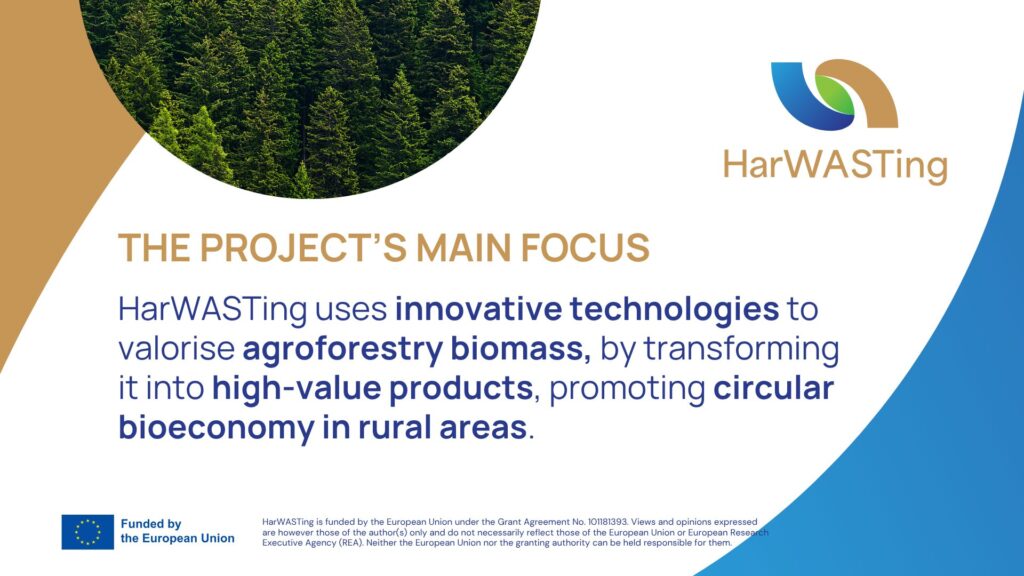
Building on this scientific breakthrough, the HarWASTing project launched in September 2024 to bring this technology closer to industrial reality.
Project Goals:
- Scale up the process from pilot to demonstration scale
- Optimize the technology for different waste streams across Europe
- Develop commercial-grade products meeting industry certifications
- Create a roadmap for industrial deployment
- Assess full environmental and economic impacts (Life Cycle Assessment)
Why “HarWASTing”?
The name combines “harvest” and “waste” – reflecting the philosophy that waste is a resource to be harvested, not a problem to be buried.
Why This Matters for Europe’s Future
1. Energy Independence
Europe imports significant amounts of wood and relies on fossil fuels for construction materials. This technology uses locally available waste, reducing import dependence.
2. Job Creation
Decentralized waste processing plants create local jobs in collection, processing, and manufacturing. Unlike exporting waste, value stays in the community.
3. Climate Action
Meeting EU climate targets requires circular solutions. Every ton of waste transformed into materials is a ton not burned or buried – and a ton of virgin material not extracted.
4. Innovation Leadership
Europe leads in circular economy policy. Technologies like this prove we can also lead in implementation, creating exportable know-how.
5. Waste as Resource
This fundamentally changes how we think about waste. It’s not garbage – it’s a chemical feedstock that we’ve learned to transform efficiently.
Common Questions
Is this safe?
Yes. The final panels meet the same safety standards as conventional particleboard and fiberboard. The process uses established technologies (pressure vessels, heat treatment) already common in chemical industries.
Will this smell bad?
No. The HTC process is contained in closed vessels. Modern industrial facilities have odor control systems. The final product is odorless carbon-based panels.
Is it really sustainable if it uses heat and pressure?
Yes. The process is significantly more energy-efficient than alternatives. Plus, the heat can come from renewable sources, and some energy is recovered from the process itself (organic liquids produced can be used as fuel).
When can I buy furniture made this way?
The HarWASTing project aims for commercial production by 2030. First products will likely be construction panels, followed by furniture applications as the market develops.
What happens to the waste I currently separate?
Keep separating your organic waste! Currently it may go to composting or biogas. As this technology scales, it will add another valuable destination option, especially for wet waste difficult to compost.
The Bottom Line
We stand at a pivotal moment. Europe has set ambitious climate goals and committed to circular economy principles. But policies alone aren’t enough – we need practical technologies that work at scale.
This waste-to-materials process is exactly that: proven science, validated at industrial pilot scale, ready for the next phase.
Through the HarWASTing project, European researchers and companies are working together to make this a reality. The goal isn’t just to manage waste better – it’s to eliminate the concept of waste entirely.
Your orange peel today could be your desk tomorrow. That’s not a fantasy – that’s chemistry, engineering, and European innovation at work.
Authors: Michael Renz, Investigador y vicedirector técnico
INSTITUTO DE TECNOLOGIA QUIMICA, UPV-CSIC