What is Harwasting about?
Our Mission and Approach
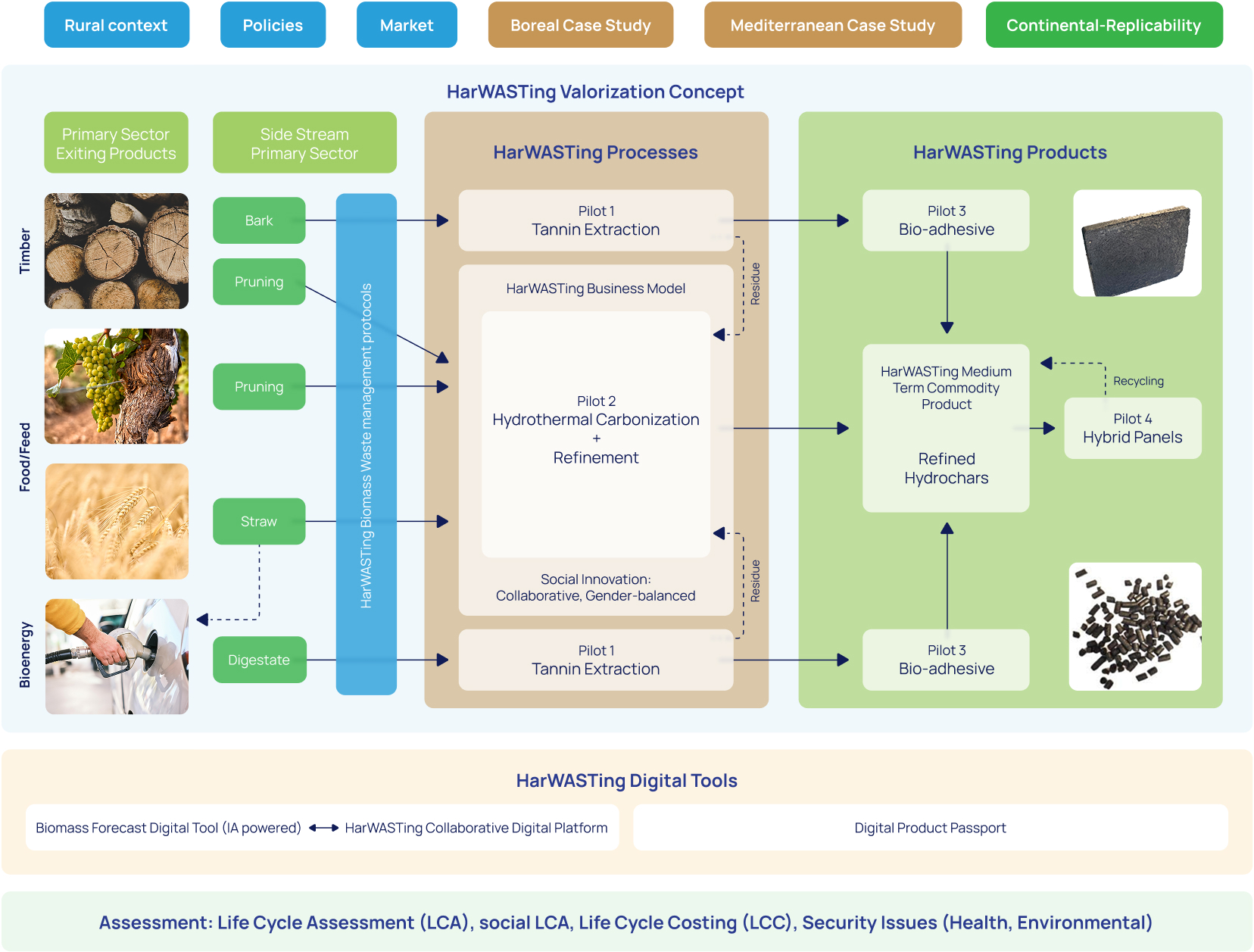
Revalorising biomass from forest and agricultural harvests, pruning waste, and bioethanol by-products can significantly advance the bioeconomy in rural areas.
Our Goals
CASE STUDIES
Bioregions
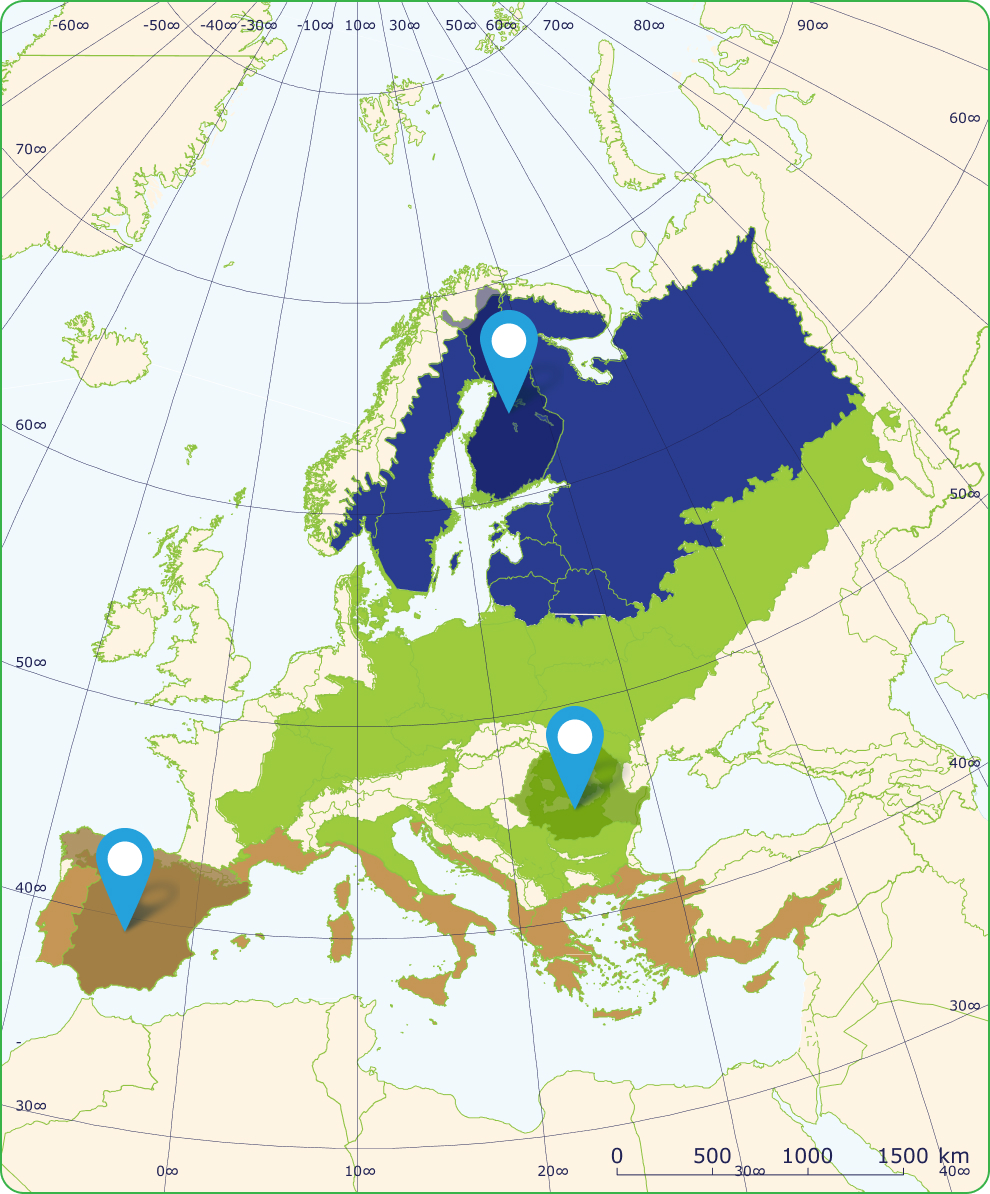
The HarWASTing project aims to develop and test innovative business models (IBMs) based on a circular and cooperative economy in two rural regions: Spain (Mediterranean) and Finland (Boreal).
The project will assess the success of these models using various performance indicators and life-cycle analyses. The goal is to demonstrate the models’ effectiveness and then study their potential for replication in a third, wider region, Romania (Continental).
- Continental
- Mediterranean
- Boreal
Case Studies
Boreal
A customised business model for the Boreal bioregion, the case study 1, and it will be developed, implemented, validated and optimised in close cooperation with Joutsenten Reitti and relevant municipalities, foresters and farmers. The focus will be on efficiently revalorising local underused biomass, in particular dry softwood (spruce) bark for tannin extraction and activating lignin from bioethanol production. Extracted tannins and lignin will be used to develop high-performance bio-adhesives for wood and hybrid panels in construction and furniture.
Mediterranean
A tailored business model for the Mediterranean bioregion will be developed, implemented, validated and optimised in close cooperation with AMUFOR, aligning what is case study 2. The focus will be on treating residues from forest and agricultural activities in an HTC pilot plant. The resulting hydrochar will be revalorised into innovative hybrid panels for the construction sector. A phenolic stream from thermal post-treatment will formulate bio-adhesives for these panels, along with those from case study 1 (Boreal Bioregion Business Model). Additionally, the aqueous phase from the HTC process will be revalorised as fertilizer and irrigation water
Continental
Hydrochar development and lignin and tannins extraction and activation). The Continental region business model will be tested and optimized in close collaboration with UTBV and APAPET. Regular feedback loops on the Boreal and Mediterranean case studies will make it possible to identify barriers or difficulties in replicating the business model, helping to optimise the guidelines for replicability,and offering policy and business recommendations to public and private stakeholders.
WORKPLAN
Project Implementation Comprises 8 Work Packages (WP)
The HarWASTing project is structured around eight interconnected Work Packages (WPs), each driving a key aspect of its mission to valorize agroforestry biomass. From strategic coordination and stakeholder engagement to digital tool development and pilot-scale innovation, the WPs collectively support the creation of sustainable bio-based products and business models. They also ensure robust impact assessment, financial support for third parties, and wide-reaching communication and capacity building to maximize the project’s long-term value.
WP1 Management, Coordination & Quality Assurance
The first work package (WP1) ensures smooth project execution by managing timelines, budgets, and quality standards, while overseeing risks, ethics, data, and gender aspects.
WP2 Case Studies & stakeholders engagement: market analysis and business models
This work package lays the groundwork by mapping EU policy, regulations, socio-economic conditions, agroforestry resources, and stakeholder needs. It includes a market analysis of key products to assess demand and customer requirements. These insights inform the design and implementation of two business models in separate case studies, to evaluate their replicability across other EU regions.
WP3 Digital support tools development
This Work Package is aimed at the development of a suite of digital tools, including an Assistant digital tool for feedstock availability forecasting, the HarWASTing Collaborative Digital Platform (HCDP) as a cloud-based B2B marketplace, and a Digital Product Passport (DPP) for high-value products. Together, they will enable the effective implementation of the project’s business models.
WP4 Biomass valorization to intermediates - From LAB to Pilot
WP4 aims to enhance waste treatment products using PHWE and HTC technologies for high-value applications. Key activities include scaling up tannin extraction and lignin activation for bio-adhesives, producing hydrochar from agroforestry residues for hybrid panels and external use, piloting sustainable water treatment from HTC processes, and developing alternative valorization pathways for pyrolysis liquids beyond energy recovery.
WP5 Final applications development - From LAB to Pilot
WP5 focuses on scaling up high-value products from biomass treatment outputs, including the development of min. two bio-adhesives from tannin, lignin, and phenolic compounds, and the production of min. three types of hybrid panels using hydrochar. These fully renewable developed products will be used in real-world applications, particularly in sustainable construction.